
You've seen the standard advice on the best time to post on social media: post at 9 am, avoid weekends, target lunch breaks. These guidelines are fine—but they're based on platform-wide averages, not your actual audience.
A SaaS team targeting San Francisco founders will see different engagement than a retail brand reaching Chicago parents or a London company posting for global buyers. Time zones, work schedules, and audience behavior all shift when people click.
That's where AI-driven insights become useful. Instead of relying on surveys or assumed patterns, Rebrandly's AI scheduling tool analyzes real clicks across billions of links to suggest optimal posting times based on your audience's specific behavior.
This guide covers platform benchmarks as starting points, then shows how location-based click data helps you identify when your audience is most likely to engage—and drive higher click-through rates.
Why posting time affects click-through rates
The timing of your posts directly affects click-through rate (CTR). Even compelling copy can underperform if posted at the wrong time.
Here's why timing plays an outsized role in link performance.
Narrow attention windows
Social media consumption happens in short, fragmented bursts. Most users don't browse feeds for long stretches. They check in between meetings, on the train, while waiting in line, or as a quick mental break.
These micro-moments create narrow attention windows where users are:
- Actively scrolling, not just skimming
- More willing to tap a link rather than bookmark or scroll past
- Mentally available to leave the platform
If your post goes live outside those windows, it gets buried under newer content by the time the user checks again. That means fewer impressions and fewer clicks, even if your content is highly relevant.
Timing determines whether your post appears during an active session or a passive scroll.
Algorithms reward early engagement
Most social platforms rely on early engagement signals to decide how widely to distribute a post. Likes, comments, shares, and clicks shortly after publishing show algorithms that your content is worth distributing.
Posting at the right time increases the likelihood that:
- Your post appears while users are actively engaging
- Early viewers click or interact quickly
- The platform boosts distribution as a result
Posting at the wrong time creates a compounding disadvantage: your content fails to gain traction because the initial audience wasn't online or wasn't in a clicking mindset.
Timing influences not only when people see your post, but also how many eventually see it.
The CTR difference timing creates
There's a meaningful difference between impressions and clicks. Thousands can see your post and still generate minimal traffic if it appears during low-intent browsing moments.
When you publish content during optimal windows:
- Users are more likely to tap links immediately
- Click-through rates increase because intent is higher
- Fewer clicks are deferred or lost entirely
During off-peak times, users might mentally save posts to come back later, but never do. That gap between interested and clicked is where CTR drops off. Optimal timing narrows that gap by aligning your post with moments when users are ready to act, not just observe.
Why branded links matter for timing analysis
Understanding the impact of posting time requires accurate measurement—and that's where branded links become essential.
Branded links let you:
- Attribute clicks to specific posts, platforms, and time windows
- Compare CTR performance across different publishing times
- Identify repeatable patterns instead of one-off spikes
Without consistent link tracking, it's difficult to know whether timing changes improve performance or whether results are driven by content, format, or channel.
By pairing branded links with scheduling insights, you can move beyond assumptions and see exactly which posting windows drive the highest click-through rates for your audience. That data feeds back into your schedule, creating a continuous loop of testing, learning, and optimization.
Posting time shapes behavior—and CTR is where that impact becomes impossible to ignore.
Platform benchmarks: Where to start
When determining the best time to post on social media, platform benchmarks provide a baseline for incorporating new channels or launching campaigns. The key is understanding what times work best for your audience and the content they prefer. These are starting points, not final answers.
Instagram engagement clusters around weekday mornings, when users take short breaks during their workday.
Best times to post on Instagram:
- 9 am - 1 pm on Monday, Tuesday, Wednesday, and Friday
- Early evenings after work
Tuesdays and Wednesdays generally have the highest consistent engagement.
Instagram's algorithm rewards early engagement. Posts that receive quick likes, comments, or saves are more likely to reach a broader audience.
Facebook audiences tend to skew older and show different weekday patterns. The best time to post on Facebook reflects that shift.
Best times to post on Facebook:
- Early mornings, between 5 am and 7 am on weekdays
- Late morning on weekends
Mondays and Tuesdays show more consistent engagement than later in the week, based on recent industry benchmark data from Sprout Social.
Facebook favors native engagement, but posts with links that appear during active browsing windows generally see higher click-through rates.
LinkedIn follows professional rhythms more closely than any other platform. You'll need to be more targeted with your social media links to see consistent engagement.
Best times to post on LinkedIn:
- 8 am - 12 pm on Tuesday, Wednesday, Thursday, and Friday per Sprout Social
- Late morning and early afternoon on Monday and Friday
Users engage with LinkedIn between meetings or at the start and end of the workday. Tuesday, Wednesday, and Thursday show the most engagement with business pages. Posting outside these windows results in lower visibility and fewer clicks.
X (Twitter)
X is a fast-moving platform where timing is less about a single post and more about consistency. Posting windows are more varied than other platforms, according to recent benchmarks.
Best times to post on X:
- Early mornings for news and time-sensitive updates
- At least once a day between 11 am and 5 pm
Because posts have a short lifespan, multiple posting windows often outperform a single "best time." Tuesday through Thursday tend to have the most engagement for business content, while weekends show less overall interest.
TikTok
TikTok's engagement patterns differ from other platforms, as does your ability to share links natively. Consider using a link-in-bio tool like Link Gallery to optimize link performance on TikTok.
Best time to post on TikTok:
- 5 pm - 9 pm on Tuesday, Wednesday, and Thursday
- 3 pm - 10 pm on Fridays
Posting earlier in the week can help content build momentum that carries into peak weekend browsing. TikTok rewards watch time and repeat views, so engagement windows are larger later in the week, according to SproutSocial.
Use these benchmarks as a baseline for each platform, then let Rebrandly's AI scheduling tool refine timing based on your audience's location and past engagement.
How Rebrandly's AI scheduling tool finds optimal posting times
Rebrandly's AI scheduling tool analyzes billions of clicks across branded links shared in social posts, bios, campaigns, and messages. We look at when your audience actually clicks, not when they say they engage.
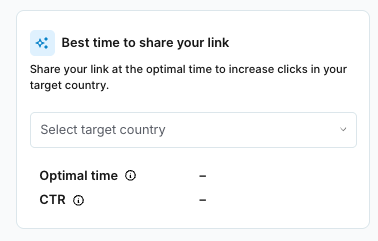
The scheduler:
- Analyzes historical click behavior across Rebrandly links
- Groups patterns by geographic region and time
- Identifies recurring windows where click-through rates spike
- Recommends optimal posting times based on location
Our recommendations adapt to your audience's unique behavior, not just platform averages.
Why location matters
Location shapes online behavior. Commuting hours, lunch breaks, work schedules, and evening routines differ significantly across regions.
A New York audience may show strong engagement during commutes. A London audience might peak earlier in the workday. An Australian audience often engages while North American teams are offline.
By factoring in location, AI surfaces timing windows that generic benchmarks miss entirely. You get data-driven posting suggestions grounded in actual click behavior. These insights don't replace strategy—they narrow the margin of error.

Testing and refining your social media schedule
Finding the best time to post on social media requires ongoing optimization. Audience behavior changes with seasons, work patterns, platform updates, and world events. The goal isn't to lock in a single perfect time, but to continually narrow in on the windows that consistently deliver the highest CTR.
Rebrandly's AI scheduling tool accelerates this process by reducing guesswork. Instead of testing dozens of random time slots, you start with a short list of data-backed windows and refine from there.
1. Start with platform benchmarks as your baseline
Platform benchmarks give you a safe place to begin, especially if you're launching a new channel or campaign. They reflect broad usage patterns and help you avoid clearly low-performing windows.
Think of benchmarks as guardrails, not rules. They prevent obvious mistakes, but they don't account for your audience's unique behaviors.
2. Enter your primary audience location into the scheduler
Once you have a baseline, location becomes the most crucial variable. By entering your primary audience geography into Rebrandly's scheduling tool, you shift from global averages to region-specific behavior.
This step is where generic advice turns into actionable insight. Local engagement patterns, work hours, and daily routines all influence when people are most likely to click.
3. Use AI-generated recommendations to select posting windows
The scheduler surfaces recommended posting times based on historical click behavior for your region. Instead of publishing across wide time ranges, you're now choosing a small number of high-probability windows.
This focus matters. Fewer, better-timed posts often outperform higher volume with inconsistent timing—especially when links are involved.
4. Publish consistently using branded links
Consistency is essential for testing. Publishing at roughly the same times each week lets patterns emerge quickly and makes performance comparisons meaningful.
Using branded links ensures each post is clearly attributable. You're not just measuring engagement—you're measuring clicks tied to a specific post, time, and platform.
5. Monitor click-through rates by time and day
After a few weeks of consistent publishing, patterns start to appear. Certain days or time blocks will reliably outperform others.
At this stage, you're no longer asking "When should we post?" but "Which of these recommended windows works best for this type of content?"
6. Adjust based on what performs best
Refinement is about small, intentional changes. Shift underperforming posts to stronger windows. Double down on times that consistently deliver higher CTR. Over time, your schedule becomes more precise.
The result is a repeatable, data-driven posting rhythm built on real behavior, not assumptions.
Advanced timing strategies to level up your posting schedule
Once you've established a reliable posting cadence, timing becomes less about finding a single optimal moment and more about strategically aligning content, platforms, and audiences.
Consistency over perfection
Posting consistently in known engagement windows almost always beats posting sporadically at perfect times. Social algorithms reward predictable publishing patterns because they train audiences to expect your content.
Consistency also improves measurement. The more stable your schedule, the easier it is to isolate what's driving performance changes—timing, content, or format.
Test multiple time slots per platform
Not all content performs equally at the same time. Educational posts, product updates, and long-form resources often perform better during work hours when users are in a learning mindset. Lighter content, promotions, or entertainment may perform better in the evening.
Testing two or three time slots per platform lets you match content type to user intent, rather than forcing everything into a single window.
Consider time zones for distributed audiences
If your audience spans regions, a single posting time can unintentionally exclude large segments. Location-based publishing or light content repurposing lets you reach different time zones without creating entirely new campaigns.
This approach is especially effective for global brands and remote-first businesses, where engagement windows vary dramatically.
Optimize experience beyond timing
Timing gets users to click, but experience determines what happens next. Traffic routing ensures users land on the most relevant destination regardless of when they click.
Device, location, and language-based routing can improve conversion rates after the click, reinforcing the value of good timing rather than replacing it.
Track cross-channel timing performance
Timing insights rarely exist in isolation. Windows that perform well on social often overlap with strong engagement periods in email or paid campaigns.
UTM parameters help connect these dots by showing how timing impacts performance across channels. Over time, you can coordinate publishing schedules across your entire marketing mix instead of optimizing each channel in a silo.
At this level, timing becomes a strategic asset—not just a scheduling detail.
Find the best time to post on social media for your audience
Generic best time to post data is a helpful starting point, but the real opportunity lies in understanding when your audience is most likely to engage. Rebrandly's AI scheduling tool uses real click behavior, analyzed by location, to recommend posting times grounded in actual performance—not averages.
By combining platform benchmarks, AI-driven insights, and branded link analytics, you can move from guesswork to strategy.
The best time to post on social media isn't universal—and with AI-powered insights, it doesn't have to be. Get location-based posting recommendations with Rebrandly and start posting when your audience is most likely to click.
Ready to get started with AI posting recommendations? Sign up for a free trial to test it out.

.jpg)
.jpg)