Timing is everything, and that applies to your Facebook marketing strategy as well. The idea is to publish your posts while your followers are the most active, so you have a better chance of engaging them and driving up your organic reach. In other words, knowing the best time to post on Facebook will help you get the most out of your social media marketing efforts.
With a total of 3.5 billion monthly users on the platform, it goes without saying that not all of those users will be online at the same time. But people in the same region or with similar lifestyles will likely share similar behavioral patterns. This means they’re probably active on social media around the same time.
This is why it’s crucial to understand the best time to post on Facebook so you know when to schedule your posts and reach your followers when they’re most likely to engage. In this post, you’ll discover when is the best time to post on Facebook based on sector and industry.
You’ll also discover how to get engagement data for your business in particular, so you can strategically plan your social media calendar and posting schedule. Let’s dive in.
Studies on the best time to post on Facebook
Multiple studies have tried to narrow down the best time to post on Facebook to drive engagement. But the results vary from study to study, which makes it all the more confusing. So when is the best time to post on Facebook according to these studies? Let’s take a look:
- Buffer – Buffer’s study found that 10 a.m. on a Friday is the best time to post on Facebook. Other high engagement times were 10 a.m. on Mondays and 9 a.m. on Tuesdays. Across all the days, mornings between 9 a.m. and 10 a.m. generally saw higher engagements.
- HubSpot – On the other hand, HubSpot’s study consisted of survey responses from marketers who said that the best times to post on Facebook are 6 p.m. to 9 p.m. and 12 p.m. to 3 p.m. Fridays and Saturdays were the best days to post, with Sunday being the worst day. Almost contrary to Buffer’s study, HubSpot found that the worst times to post were 6 a.m. to 9 a.m. and 9 p.m. to 12 a.m.
- Sprout Social – While the Buffer and HubSpot studies share common ground on Friday being the best day to post, the Sprout Social study reveals something different. Their analysis found that the best times to post on Facebook were Mondays from 8 a.m. to 1 p.m., Tuesdays from 8 a.m. to 2 p.m., Wednesdays from 8 a.m. to 1 p.m. and Thursdays from 8 a.m. to noon.

Considering these top studies, the periods between 9 a.m. and 3 p.m. from Monday to Friday are generally the safest times to post on Facebook. But the optimal post timing may also vary by geographic location and industry, so you should take that into consideration as well.
Best time to post on Facebook by industry
As mentioned above, the best time to post on Facebook varies by industry. Different industries each have a unique type of audience that uses the platform in different ways. Some industries may have audiences that typically use Facebook at work, while others may have audiences that normally access the platform from their homes.
Similarly, your audience will have certain expectations about when they should receive your updates based on the kind of information you’re providing. For example, news and media companies should prepare to give their followers the latest news early in the morning and in the evening.
As such, audience behavior and engagement time will vary from industry to industry. Sprout Social conducted an extensive study collating social media engagement data on 400,000 profiles to determine the best times to post on social media. Based on this study, they narrowed down the best time to post on Facebook for different industries.
- For consumer goods – Monday was the best day to post for businesses dealing in consumer goods. The best times to post were Mondays at 7 p.m., Tuesdays from 6 p.m. to 8 p.m., and Fridays from 6 p.m. to 8 p.m. In general, there were no worst days to post.

- For healthcare – Accounts in the healthcare sector saw the most engagements on Mondays through Thursdays from 9 a.m. to noon. This extended to 1 p.m. on Fridays. 1 p.m. to 8 p.m. on Mondays and Tuesdays, 6 p.m. to 8 p.m. on Wednesdays, 4 p.m. to 7 p.m. on Thursdays and 1 p.m. and 7 p.m. on Fridays also had high engagement rates.
- For hospitality – In the hospitality sector, accounts typically saw high engagements throughout the day from Monday through Thursday. The best times to post on Facebook in this industry were Mondays from noon to 9 p.m., Tuesdays from 10 a.m. to 9 p.m., Wednesdays from 11 a.m. to 8 p.m., Thursdays from 10 a.m. to 6 p.m., and Fridays at 3 p.m. and 6 p.m. to 8 p.m.
- Media – As mentioned earlier, audiences expect to get the news in the morning, which explains why the media sector sees peak engagements during this period. The study found that the best times to post on Facebook for this industry were Mondays from 8 a.m. to 2 p.m., Tuesdays from 7 a.m. to 3 p.m., Wednesdays from 6 a.m. to 1 p.m. and Thursdays from 11 a.m. Weekends were relatively the worst days to post.
- Nonprofits – Mondays and Wednesdays from 11 a.m. to 1 p.m. were the best times to post on Facebook for nonprofits. On Tuesdays, they saw the highest engagement between 10 a.m. and 4 p.m. Sundays were the worst days to post.
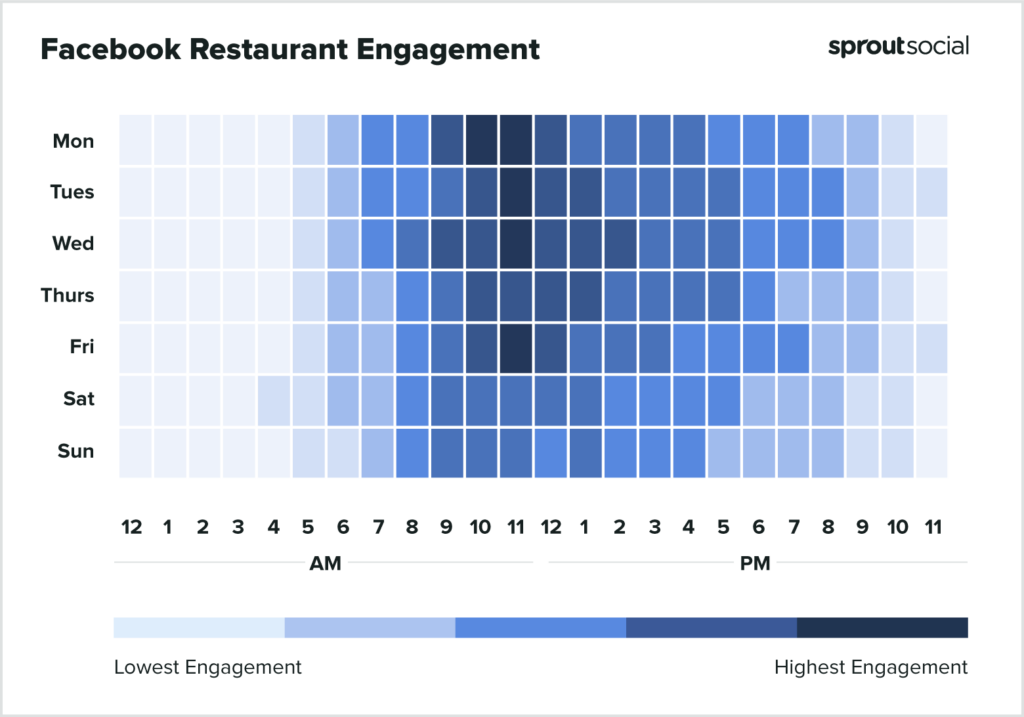
- Restaurants – For restaurants, the best time to post on Facebook was between 10 a.m. and noon on Mondays. On Tuesdays, Wednesdays, and Fridays, 11 a.m. was the best time to post. Weekends saw relatively lower engagement.
- Schools and education – In the education sector, 9 a.m. to noon was the best time to post on Facebook on Mondays and Wednesdays. The high engagement time was extended to 1 p.m. on Thursdays. Meanwhile, 8 a.m. to 1 p.m. was the best time to post on Tuesdays. On Fridays, 10 a.m. was the peak engagement time.
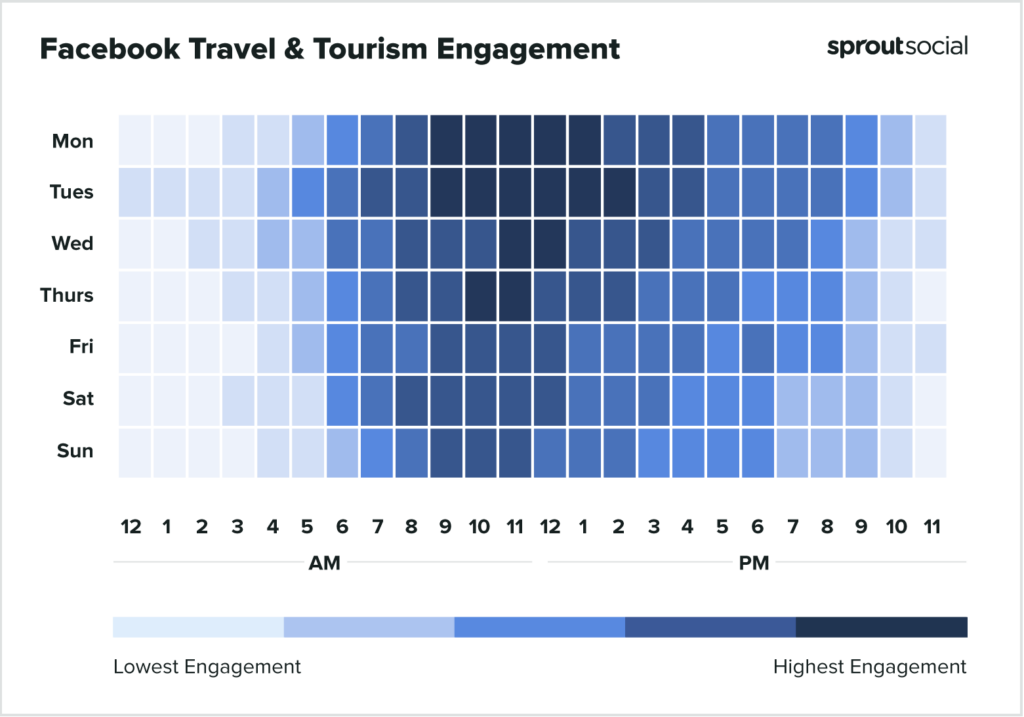
- Travel and tourism – For businesses in the travel and tourism sector, peak engagement times were Mondays from 9 a.m. to 2 p.m., Tuesdays from 9 a.m. to 3 p.m., Wednesdays from 11 a.m. to 1 p.m., and Thursdays from 10 a.m. to noon.
So when is the best time to post on Facebook?
What’s clear from the varying findings from these studies is that there’s no universal “best time to post” on Facebook for every business. Even if you follow the industry-specific findings, you might still have some trouble getting the kind of engagement you expect because every business is different. So does that mean you should throw these studies out the window? Not necessarily.
If you were to find the best time to post for your business in particular, you’d have to schedule your posts for every hour of the day throughout the week. And then there’s the whole process of analyzing the results to see which days and hours see the best results.
This can be time-consuming and expensive. But these studies give you a general idea of what post timings you should test first based on what works for other businesses in your industry. They help you narrow down which hours and days might give you the best results so you know which timings you should prioritize in your experiments.
This gives you an idea of the best times to post on Facebook so you can develop an experimental posting schedule. Then look at the performance of the posts you’ve published and see which timings tend to drive the most engagement. This will help you come up with a more solid posting schedule to get consistent engagements for your future posts.
If the data from Facebook Insights is a bit limited, you can also use third-party social media monitoring tools to get time-related engagement data.
But don’t just stop at engagements either. See which post timings drive the most action in the form of clicks. This is crucial because someone liking your post doesn’t necessarily translate into action or page visits. Sometimes, the user might only have time to quickly browse through their feed and engage with posts.
If they’re on a short break at work or if they’re in transit to and from work, they might not have enough time to click on your link and visit your website. This makes it vital to understand when people are most likely to click on the links you share on Facebook, so you can adjust your posting schedule accordingly.
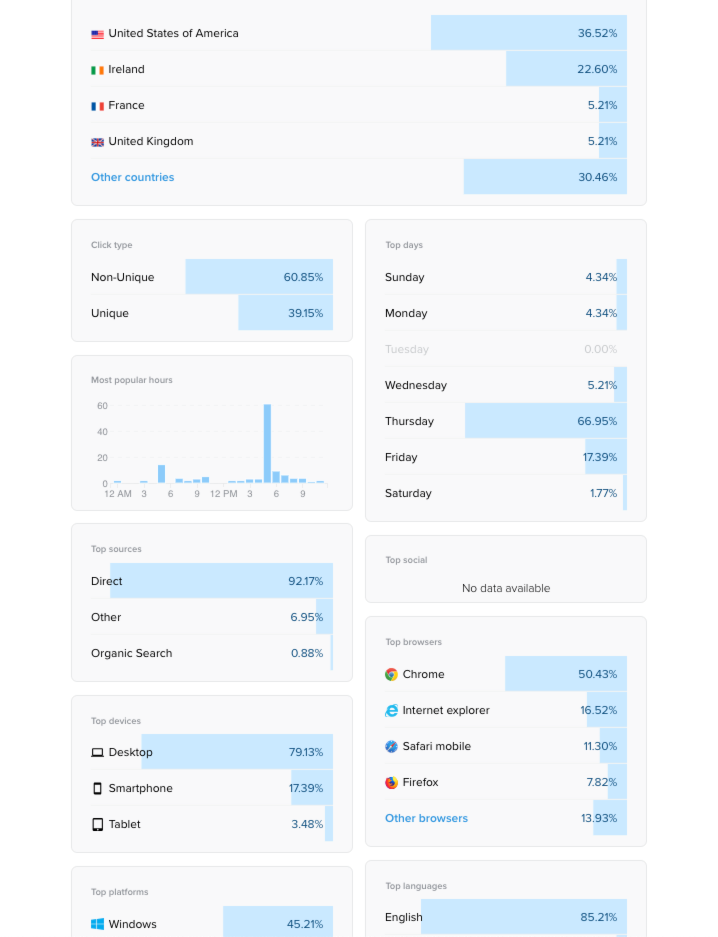
Use the Rebrandly link analytics to see on which days and hours you get the most clicks from Facebook. And then use this data to come up with a Facebook posting schedule that’s bound to get you optimal engagement and clicks. You can even use this report to track the performance of your branded links on other platforms.
Better yet, you can use Rebrandly AI to get automated suggestions on the best time to post on Facebook. Rebrandly AI conducts a deep analysis of billions of data points such as clicks and engagement. It then uses machine learning and neural network algorithms to provide suggestions on the best time to post a link for higher click-throughs and deliverability.
The takeaway
Knowing the best time to post on Facebook is a necessary step if you want more organic visibility and engagement on the platform. Although it won’t be wise to rely on these studies alone, use them as a basis to run your initial test. The goal is to see what works for you specifically and then develop an effective posting schedule based on these results.
When is the best time to post on Facebook for your business? Let us know in the comments.

.jpg)
.jpg)